

A blocked pump, worn impeller or overloaded biological tank can look like an isolated maintenance problem. Quite often, it is not. The real trouble started much earlier, when material that should have been removed or controlled at the inlet was allowed to travel deeper into the treatment plant.
This is the reason why wastewater pre-treatment requires more attention than is normally afforded to it. Although pre-treatment is not the most complicated part of the wastewater treatment process, it is indeed the security for nearly everything that follows. Screens are used for removing large objects. Grit systems are designed to eliminate heavy inorganic matter. Flow control measures make it possible to minimize hydraulic fluctuations.
When everything is done properly in the first steps of treatment, there are more chances for effective treatment in later stages as well.
What Does Wastewater Pretreatment Actually Do?
Wastewater pretreatment has a simple objective: To get rid of or otherwise address any inputs that could either cause problems for equipment, have an impact on treatment efficiency, or create other difficulties further down the line.
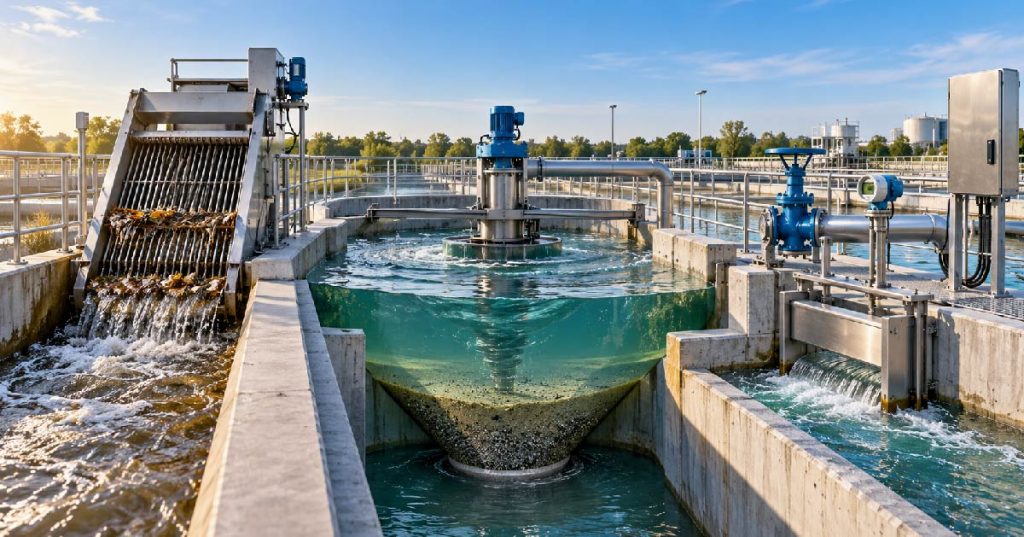
The pretreatment process in wastewater treatment facilities is normally implemented at the beginning. Depending on the type of plant, pretreatment methods could include coarse screening, fine screening, grit separation, flow measurement, equalization, oil and grease removal, among others.
This “preemptive” action is important because it collects and removes all sorts of unexpected materials, given the raw wastewater composition. In addition to dissolved and suspended pollutants, it may also contain fabrics, plastics, packaging, stones, metal parts, etc.
Wastewater Screening: Keep the Big Problems Out
Wastewater screening is usually the first physical barrier between incoming wastewater and the treatment plant.
Screens intercept material that should never reach pumps, pipes, clarifiers or biological systems in the first place. Depending on the source, that could include cloth, plastic, paper, wood, packaging debris and other coarse solids.
The principle sounds simple, but screen selection deserves some thought.
Coarse Screens
Coarse screens have relatively wider openings and are generally used to remove larger debris. Their main role is protection. By catching bulky material early, they reduce the likelihood of blockages and mechanical damage downstream.
Fine Screens
Fine screens use smaller openings and capture smaller solids that would pass through coarse screening. They may be useful where downstream treatment equipment is more sensitive or where reducing solids loading early provides an operational advantage.
Choosing between screen types is not simply a question of “finer is better.” Smaller openings can capture more material, but they also require effective cleaning and screenings handling.
Poorly maintained wastewater screening can itself become a bottleneck. A partially blocked screen increases head loss, disrupts flow and may force operators into frequent manual intervention. The screen therefore needs to be selected with peak flow, debris characteristics, cleaning method and disposal requirements in mind.
Why Grit Needs Its Own Treatment Step
A screen can remove a plastic bag. It will not reliably remove sand.
This is where grit removal in wastewater treatment becomes important.
Grit generally refers to dense inorganic material such as sand, gravel, eggshell fragments and similar solids that settle much faster than typical organic wastewater solids. If allowed to pass downstream, this material can accumulate in channels and tanks, reduce useful volume and accelerate wear on mechanical equipment.
Pumps are particularly vulnerable. Abrasive particles moving repeatedly through pumping systems can contribute to wear, while grit settling in places where it is not expected can create difficult cleaning and maintenance work.
Common grit-removal approaches include horizontal-flow, aerated and vortex systems. Their designs differ, but the objective is similar: create hydraulic conditions in which heavier inorganic particles are separated while most lighter organic matter continues through the process.
Effective grit removal in wastewater treatment should therefore be judged not only by how much material is collected, but by what is being collected. Removing large amounts of organic matter along with grit may create avoidable disposal issues and indicate that the separation conditions need attention.
Wastewater Flow Control: The Problem You Cannot Screen Out
Not every pretreatment problem is a solid.
Flow itself could become one of the biggest operating problems to deal with.
Wastewater that comes into a treatment facility usually does not arrive at a completely constant pace. Municipal systems fluctuate hourly, but industrial treatment plants can sometimes see an even stronger variation, as production workflows start, stop, wash or discharge wastewater.
If there isn’t sufficient flow control, then these peaks will quickly sweep through the plant.
The biowastewater treatment system that was constructed with complaints of relatively steady flow in mind may prove unsuitable if there are sudden huge contaminations or mass flows coming all of a sudden. Risks of higher overflow rates in clarifiers as well as difficulties in chemical dosing and contact time regimens could arise.
That is where the system of equalization can save the day.
The equalization tank holds different flows at a certain moment of time and lets it out later at a reasonable pace downstream. Also, it could be very effective in cutting concentration fluctuations depending on the specifics of the constructed equalization circuit.
Good wastewater flow control does not necessarily mean making every flow perfectly constant. The goal is to reduce the degree of fluctuation enough that downstream processes can operate within an acceptable range.
How the Pretreatment Stages Work Together
One of the easiest design mistakes is to look at each preliminary step separately.
In practice, screening, grit extraction and equalisation process are interrelated.
The reason for this is that if big objects are not removed properly at the screening stage, it can block up pumps or mixers in the equalisation tank. If the grit enters the tank, the material can build up at the bottom and result in a gradual decrease in volume. That is, excessive loss in the sewage plant can affect upstream processes.
Thus, it is necessary to plan wastewater treatment methods as an integrated process rather than as a variety of equipment.
This logic is equally applicable to operational activities.
The plant may set to have a grit issue while the actual problem is velocity control. Being overloaded, the screen may show big pollutant inflow instead of insufficient screen capability. Frequent pump failures may lead back to pretreatment as opposed to the problem with the pump itself.
Common Pretreatment Mistakes
The first is undersizing equipment around average flow alone. Average flow is useful, but peak conditions are often where preliminary systems are tested most severely.
Second, installing machinery without making plans for removed material means that screening and grit still has to be collected, washed (if needed) and disposed of.
Also, maintenance access is ignored. A screen or grit unit is difficult to inspect and clean will become a process problem at some point, regardless of the good design it had on paper.
One could also call another mistake the fact that wastewater flow control is considered optional whereas nature of the incoming water has already impacted process stability. Sometimes a downstream plant is not poorly designed; instead, it is simply faced with incoming water flows it was not designed for.
How Ion Exchange Approaches Wastewater Pretreatment
Ion Exchange Arabia for Water provides integrated water and wastewater treatment solutions for industrial and infrastructure applications in Saudi Arabia. Its wastewater capabilities sit within a broader portfolio that includes engineering, wastewater recycling, Zero Liquid Discharge, membranes, automation and lifecycle services.
That integrated approach is particularly relevant at the pretreatment stage. Screening, grit handling or equalisation should not be designed without considering the characteristics of the wastewater and the treatment technology downstream.
For example, an industrial wastewater treatment plant feeding membrane processes may need tighter solids management than a conventional system. A sewage treatment plant experiencing large flow peaks may need hydraulic management before additional biological capacity is considered.
The right wastewater pretreatment design begins with actual influent conditions, plant objectives and downstream process requirements rather than a standard equipment list.
Final Thoughts
The front end of a wastewater treatment plant rarely attracts the most attention, yet failures there can be felt throughout the facility.
Good wastewater pretreatment removes damaging debris, separates abrasive grit and reduces disruptive flow variations before they reach more sensitive treatment stages. That means fewer avoidable blockages, more predictable hydraulic conditions and a better operating environment for the rest of the plant.
If screens are frequently choking, grit is appearing where it should not, or downstream treatment is struggling with changing flows, the answer may be upstream.
Connect with Ion Exchange experts to assess the complete pretreatment and wastewater treatment process and identify an approach suited to your plant’s actual operating conditions.
FAQs
What is wastewater pretreatment?
Wastewater pretreatment is the first stage of treatment used to remove large debris, grit and other materials or hydraulic variations that could interfere with downstream equipment and processes.
What is included in preliminary wastewater treatment?
Preliminary wastewater treatment commonly includes screening, grit removal, flow measurement and, where required, equalisation. Additional processes may be included depending on the wastewater source.
Why is wastewater screening important?
Wastewater screening protects pumps, pipes and treatment equipment by removing large solids such as plastics, rags and other debris before they travel deeper into the plant.
How does grit removal work in wastewater treatment?
Grit-removal systems create conditions that allow dense inorganic particles such as sand and gravel to settle or separate while lighter organic material remains in the wastewater stream.
Why is flow equalisation used in wastewater treatment?
Equalisation helps reduce sudden changes in influent flow and loading. This can provide more stable conditions for downstream physical, chemical and biological treatment processes.