
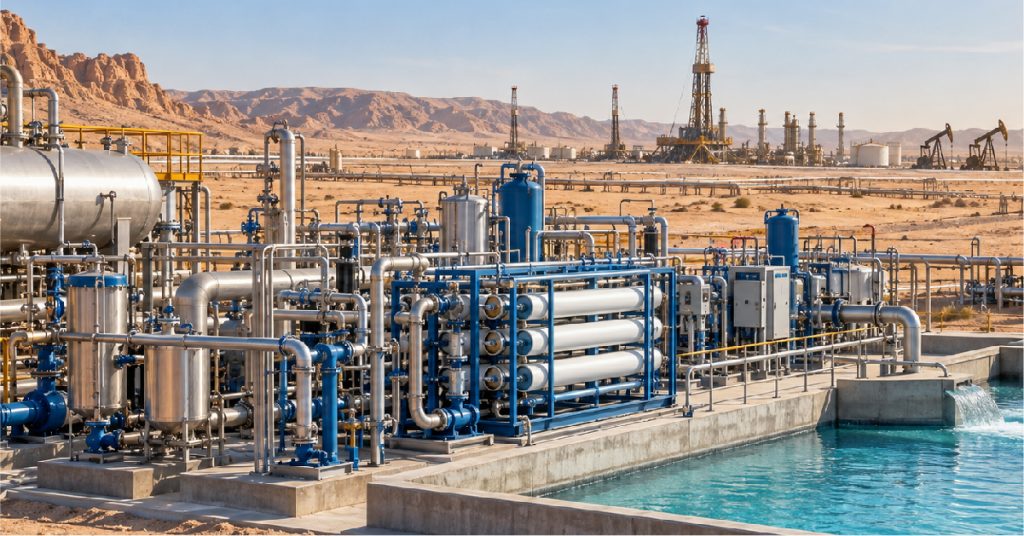
Saudi Arabia’s produced water treatment market is valued at about USD 1.3 billion, reflecting rising demand for water recycling and advanced treatment in the oil and gas sector. As the Kingdom advances Vision 2030 water goals, managing oilfield wastewater is becoming an operational priority, not simply an environmental task.
What Is Produced Water in Oil and Gas Operations?
Produced water refers to water found in the geological formations containing hydrocarbons during the extraction of the latter along with the crude oil. Produced water is water that contains free oil, dissolved oil, solid particles, salts, heavy metals, chemicals used during the treatment processes, hydrogen sulphide, carbon dioxide, as well as radioactive materials.
Its chemistry can change considerably from one field to another. That makes treatment design less about choosing a single technology and more about building the right sequence around actual water quality and the intended end use.
Why Produced Water Volumes Are Rising in Saudi Arabia
As oilfields mature, the proportion of water produced with crude generally rises. In some fields, the water cut can reach 80–90%, meaning operators may eventually handle far more water than oil at the surface.
For Saudi operators, higher volumes increase pumping, separation, treatment and disposal loads. Scalable oil and gas water treatment therefore becomes a business necessity rather than simply a compliance expense.
Why Treatment Matters for Saudi Operations
If water is not handled correctly, it leads to contamination of well input, increase of required pumping pressure, and also high disposal costs. On the other side, the high quality of water eases reinjection processes.
The case of Qurayyah Sea Water Plant in Saudi Aramco shows a strong bonding between water handling and production processes. The company utilizes treated sea water when injecting into reservoirs instead of groundwater.
Key Produced Water Treatment Technologies Used in Saudi Arabia
Effective produced water treatment technologies are typically arranged in primary, secondary and tertiary stages. The objective is straightforward: remove each contaminant where treatment is most technically and economically efficient.
Primary Treatment — Gravity Separation and De-Oiling
Gravity separators, plate coalescers, hydrocyclones and centrifuges remove free oil and bulk solids.
Saudi Aramco’s 2019 field test of a disk-stack centrifuge offers a useful real-world example. The technology was assessed after plate-coalescer and electrostatic separation approaches faced difficulty with fine oil droplets. The centrifuge achieved effective de-oiling despite fluctuating feed conditions.
Secondary Treatment — Flotation and Filtration Systems
Induced gas flotation, walnut shell filtering, and multimedia filtration techniques are used to eliminate the minute oil droplets as well as suspended particles from the liquid that have escaped the primary separation process.
The step is crucial before the reinjection of the liquid. If any solids remain in the liquid after the treatment process is over, these solids cause trouble with the formation permeability and raise the pressure requirements for the reinjection process. Overall, it can be argued that oilfield wastewater treatment is not just about achieving water quality standards but also about securing the safety and integrity of expensive equipment used to inject the processed wastewater.
Tertiary Treatment — Membrane and Ion Exchange Systems
Where higher-quality water is required, ultrafiltration, nanofiltration, reverse osmosis and ion exchange provide additional polishing.
The right combination depends on salinity, hardness, sulphates, silica and the planned reuse route. Advanced produced water treatment systems increasingly combine physical separation, membranes and targeted polishing rather than expecting one technology to manage every contaminant.
Produced Water Reuse and Reinjection in Saudi Oilfields
Produced water reuse generally follows two routes: reservoir reinjection or reuse within surface operations.
The process of reinjection can aid reservoir management and minimize the need for alternative sources of water. To the extent that the quality of the water allows, treated water can also be used for different process or utility applications. Studies have been carried out by Saudi Aramco mainly targeting the desalination of the water produced by oil extraction to reuse this water for process and utility purposes as a part of a more circular approach to its water management.
Zero Liquid Discharge — Moving Toward Circular Water Use
Saudi Aramco has also developed Zero Liquid Discharge technology for oilfield water. Its approach removes contaminants and salts so treated water can be recovered rather than lost as a waste stream.
Aramco reported that ZLD technology was deployed during 2024 and that recovered distillate was reused for fracturing operations. This pushes produced water reuse beyond conventional disposal thinking and toward a circular water model.
Regulatory Drivers and Environmental Compliance in KSA
Saudi Arabia’s National Water Strategy 2030 is built around sustainable management of water resources, environmental protection and cost-effective water services. Saudi environmental regulations also address protection of aqueous environments and prevention of hydrocarbon contamination of water resources.
For oil and gas operators, this means water quality, monitoring, reuse and responsible disposal increasingly need to be treated as core operating disciplines.
Challenges in Oilfield Wastewater Treatment in Saudi Arabia
There is no universal Saudi produced-water profile. Salinity, hydrocarbons, suspended solids and scaling ions can vary significantly by reservoir and over the life of a field.
Remote desert installations create another practical challenge. Treatment assets must remain reliable under changing flows while limiting unnecessary chemical consumption, maintenance and operator intervention.
This is why the best oil and gas water treatment design is rarely the one with the most equipment. It is the system that achieves the required quality and recovery at a sustainable lifecycle cost.
How Ion Exchange Supports Produced Water Management
Ion Exchange Arabia For Water, Ion Exchange’s Saudi joint venture with AWJ Energy, provides water and environmental management solutions for sectors including oil, gas and petrochemicals. Its portfolio includes ion exchange resins, membranes and integrated treatment solutions.
Ion Exchange also brings documented regional produced-water experience. In Oman, the company supplied oil-removal and specialty ion exchange resin treatment for steam-injection service. Another project incorporated pretreatment, nanofiltration and reverse osmosis for produced-water reinjection.
For Saudi facilities evaluating produced water treatment systems, that integration capability matters. Membranes need protection. Scaling has to be controlled. Recovery targets need to reflect feed chemistry. Every stage must work as part of the same water balance.
Key Statistics — Saudi Oilfield Water Management
- Saudi produced-water treatment market: approximately USD 1.3 billion.
- Water cut in some oilfields: up to 80–90%.
- Saudi water and wastewater treatment market: USD 4.03 billion in 2024, projected to reach USD 7.43 billion by 2033.
- Forecast CAGR for the broader market: approximately 7.05% between 2025 and 2033.
- Aramco freshwater consumption in 2024: 83 million m³, down 7.7% year on year.
Future Trends in Oil and Gas Water Treatment in Saudi Arabia
Just increasing treatment machinery won’t be enough in the next step; treatment will have to become more flexible.
Digital monitoring and digital twins can help the operators identify fouling, overdosing of chemicals and process drift earlier. The same goes for electrocoagulation, advanced membranes and high-recovery desalination as well.
What Is MBR in Sewage Treatment?
A membrane bioreactor combines biological wastewater treatment with membrane filtration. The membranes separate treated water from biomass, helping produce high-quality effluent within a relatively compact footprint.
Is MBR Suitable for Businesses in Singapore?
It can be, particularly where space is limited, treated-water quality needs are high or reuse is being considered. Suitability should still be confirmed through wastewater analysis and process design.
How Do I Choose a Water Treatment Company in Singapore?
Compare process expertise, regulatory understanding, technology range, project references, lifecycle costs and after-sales support. A strong supplier should understand your wastewater before recommending equipment.
Can Treated Wastewater Be Reused?
Yes, in suitable applications and with the required treatment quality. Additional polishing or disinfection may be necessary depending on how the recovered water will be used.
What Technologies May Be Included in an Industrial Water Treatment System?
Depending on the application, a system may combine pretreatment, biological treatment, filtration, membranes, ion exchange, reverse osmosis, disinfection, monitoring and automation.
Final Thoughts — Treating Produced Water for a Sustainable Saudi Energy Future
Produced Water Treatment now sits at the intersection of production reliability, water security and environmental performance. As Saudi Arabia pushes for more efficient resource use, operators need treatment strategies built around real water chemistry, reuse objectives and lifecycle economics.
Ion Exchange brings integrated experience across filtration, membranes, resins, wastewater treatment and ZLD. For operators reviewing oilfield wastewater treatment options, the better starting point is the complete water balance—not an isolated piece of equipment.
Explore our produced water treatment solutions or talk to our water treatment experts about developing an integrated treatment train for your field conditions.
Frequently Asked Questions
What is produced water in oil and gas operations?
Produced water is formation water brought to the surface with oil or gas. It may contain hydrocarbons, dissolved salts, suspended solids, metals and production chemicals.
Why is treating produced water critical in Saudi Arabia?
Treatment can protect equipment and injection wells, support environmental compliance, reduce disposal requirements and help conserve freshwater in an extremely water-scarce region.
What are the main produced water treatment technologies?
Common technologies include gravity separation, hydrocyclones, flotation, multimedia filtration, ultrafiltration, nanofiltration, reverse osmosis, ion exchange and ZLD.
Can produced water be reused in Saudi oilfields?
Yes. Depending on the achieved water quality, treated produced water can be reinjected into reservoirs or reused for selected process and utility applications.
What is Zero Liquid Discharge for produced water?
ZLD is a high-recovery treatment approach that separates reusable water from concentrated salts and contaminants, significantly reducing or eliminating liquid waste discharge.