In a power plant, condensate may look clean enough to send straight back to the boiler. After all, it has already been through the steam cycle. But appearances can be misleading. Even tiny amounts of sodium, silica, chloride or corrosion products can create problems when water repeatedly circulates through high-pressure equipment. Ion Exchange addresses this challenge through specialised condensate polishing systems and INDION® resins designed to improve condensate purity and protect critical boiler components.
For power plant operators, the concern goes beyond water quality alone. Deposits on heat-transfer surfaces, corrosion and turbine contamination can affect plant reliability. Removing impurities before condensate returns to the steam-water cycle is therefore an important part of maintaining stable operation.
Why Does Condensate Need Further Treatment?
The steam that leaves the turbine transforms into water. It is assumed that under perfect conditions the water produced in this process would be pure.
Reality however is different.
In particular, an effective condenser operating under normal conditions does not provide 100% leak-proof performance and the opening for cooling water can be a source of impurities. Corrosion in pipes or equipment can generate iron or copper oxides. Impurities can additionally enter the condensate during start-up and shutdown processes and changes in modes of operation.
Impressions of these impurities can be negligible, and in some cases even be measured in parts per billion.
Despite this fact, impurities can have a significant effect on the working of high-efficiency boilers.
Under working conditions where soluble impurities accumulate, including corrosion and deposit formation, withdrawal of contaminants once entered the steam-water circuit becomes a challenge.
Therefore it is very important to treat the condensate in the plants equipped with high pressure boilers.
What Happens Inside a Condensate Polishing Unit?
A condensate polishing unit, commonly called a CPU, treats recovered condensate before it returns to the feedwater system.
Its job is to remove dissolved ionic contaminants and, depending on the design, suspended corrosion products.
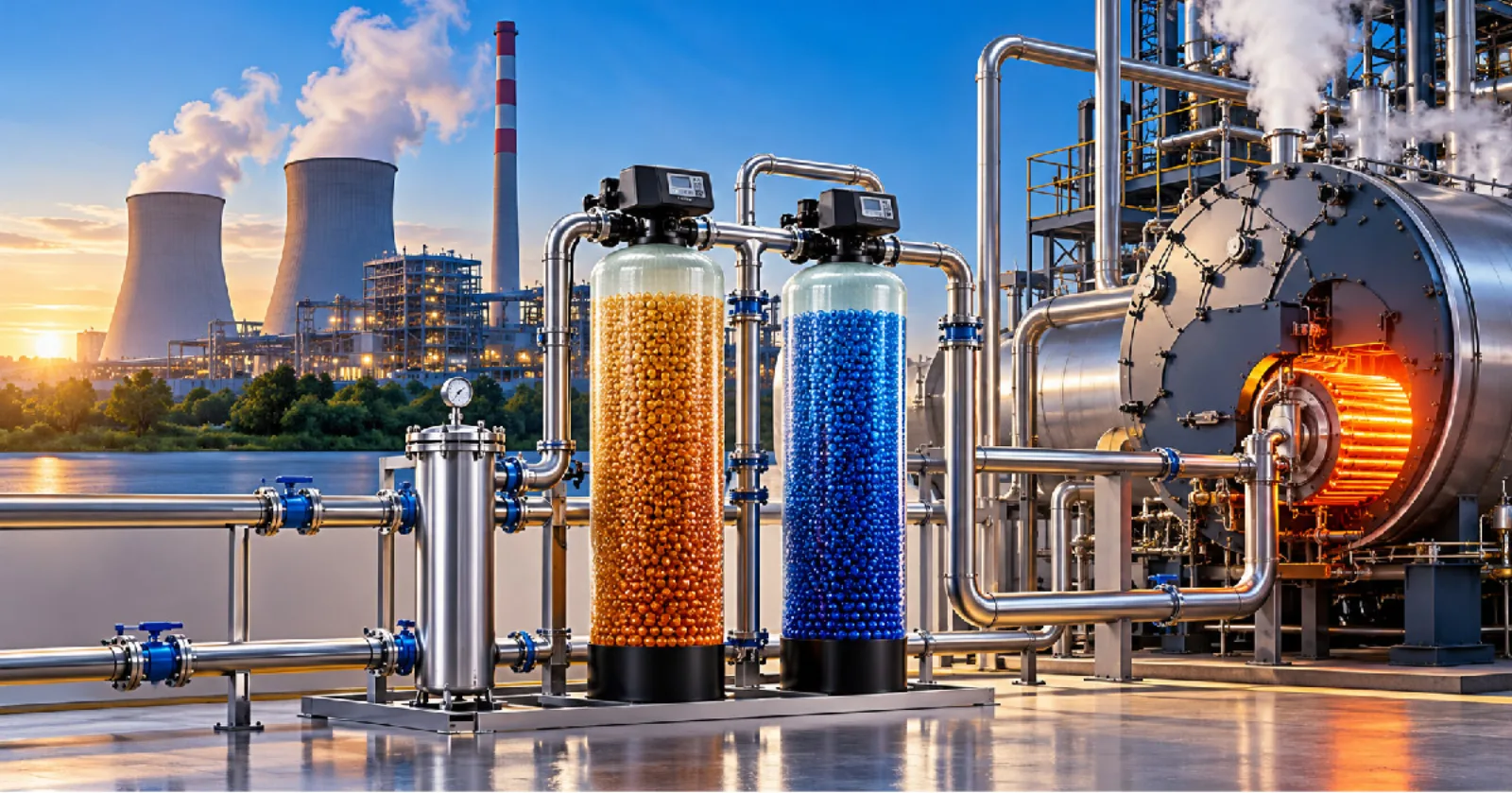
Many units use a mixed bed containing two types of ion exchange resin.
The cation resin removes positively charged ions such as sodium and calcium. The anion resin removes negatively charged ions, including chloride and sulphate, as well as certain forms of dissolved silica.
Together, these resins can produce highly purified condensate suitable for demanding steam-water cycles.
The actual performance depends on resin condition, operating temperature, flow rate, regeneration quality and the chemistry of the incoming water.
A CPU is therefore much more than a vessel filled with resin. It is a carefully controlled part of the plant's water chemistry system.
Why Ion Exchange Resins Matter So Much
The quality of the resin directly affects how effectively contaminants are removed.
For this application, resins must provide high ionic purity, suitable exchange capacity and reliable performance under the intended hydraulic and temperature conditions.
Mixed-bed systems are widely used because they allow cation and anion exchange to take place within the same vessel.
However, ion exchange resins for condensate polishing need careful selection. Resin particle characteristics, separation behaviour, mechanical strength and regeneration efficiency all influence performance.
A resin that works well in a conventional demineralisation plant may not automatically be the best choice for a condensate polisher operating at high flow rates.
This is where application-specific resin selection becomes important.
The Challenge of Resin Regeneration
Over time, resins become exhausted as they capture impurities and interact with the chemistry of the condensate.
Regeneration restores their exchange capacity, but the process requires considerable care.
In many mixed-bed systems, the cation and anion resins are separated before regeneration. The cation resin is typically regenerated with acid, while the anion resin is treated with alkali.
After washing and preparation, the resins are remixed and returned to service.
The difficult part is achieving effective separation.
If cation resin remains mixed with the anion fraction, or vice versa, regeneration chemicals can create unwanted ionic contamination. This may later appear as sodium or chloride leakage into the treated condensate.
Good condensate treatment therefore depends on the regeneration process as much as on the resin itself.
What Happens During a Condenser Tube Leak?
A leaking condenser represents a case in which the benefits of the condensate polishing unit can be huge.
Cooling water coming into the steam-water loop from a broken condenser tube may bring dissolved salts into the system.
The severity of the process depends on the composition of water, amount of the leak and operating conditions of the power plant.
A good CPU can be helpful in trapping ionic impurities and gives operators extra time to detect and handle this issue.
However, the unit cannot do miracles.
Major leaks can overwork the CPU, and it is still necessary to stick to operating limits of power plant and shutdown procedures.
The latter is especially relevant for boiler water treatment since adherence to strict chemistry provides protection for costly pressure parts and turbine machines.
Benefits of Condensate Polishing in Power Plants
The benefits become clearer when viewed across the complete steam-water cycle.
Better condensate purity reduces the amount of dissolved contamination returning to the boiler. Removal of corrosion products can also help limit deposits on heat-transfer surfaces.
During startup, polishing may support faster cleanup of the steam-water cycle, helping the plant reach acceptable water chemistry sooner.
For drum-type boilers, improved condensate purity may reduce blowdown and makeup-water requirements under suitable operating conditions.
There can also be longer-term maintenance advantages.
Reduced impurity ingress helps limit the conditions that contribute to corrosion and deposition. This supports equipment protection, although the actual benefit depends on overall cycle chemistry and plant operation.
The value of condensate polishing is therefore closely linked to reliability, not simply the volume of water being treated.
Choosing the Right Condensate Polishing System
There is no one CPU configuration applicable to all power stations. Different types of plants are likely to apply deep bed mixed resin systems. Others might simply have some filtration stages or resin configurations to combat their types of contaminants.
The nature of the power station’s operation, i.e.: boiler pressure, condenser cooling water properties, amount of incoming corrosive deposits, operational temperature, and treatment-requiredness are important factors for a decision.
Another significant aspect taken into account is regenerating systems.
Besides, plants must have a well-organized plan of resin operation, chemical storage, backwashing and regeneration.
For re-use, retrofitting of an existing power station’s system might prove to be complicated in terms of layout arrangements and piping.
Monitoring Condensate Quality During Operation
Installing a polisher is just one part of the process. Then it is up to the operators to ensure that it is operating correctly.
Useful indicators of condensate purity are conductivity, cation conductivity, sodium and silica. In some plants, it may also be required to measure chloride, sulphate and the products of corrosion.
Changes
Differential pressure across the unit is another critical parameter. An increasing value usually means that there is a build-up of solids or hydraulic limitations.
Careful monitoring will allow the operators to determine when the resin needs attention and whether the treated condensate is still of adequate quality.
Boiler water treatment depends on the operation of the system rather than its design.
Ion Exchange's Expertise in Condensate Polishing
Ion Exchange offers condensate polishing systems and specialized INDION® resins for various power generation activities.
The company's services deal with the issue of corrosion substances and dissolved impurities that may enter the condensate circuit due to normal operation or occurrence of leaks in the condensers.
One of the examples of the application of INDION® 2250 H and INDION® GS 3000 OH resins in the condensate polishing system is a facility with the capacity of 660 MW located in Madhya Pradesh.
This case is related to purification of the condensate before it reaches the steam generation loop; the process concentrates on ensuring ionic purity and resin regeneration.
For the power generation plants that consider ion exchange resins for condensate polishing, this first-hand experience of application is important because it provides information about the performance of the resin, which is to be examined in conjunction with the design of the CPU, regeneration system and operational chemistry.
Ion Exchange also provides a range of other solutions including demineralization, process-water treatment, and water management technologies associated with power generation facilities.
Protecting Boiler Performance Starts With Cleaner Condensate
Condensate may already be part of a closed steam-water cycle, but that does not guarantee it remains free from contaminants.
Condenser leakage, corrosion products and operational disturbances can introduce impurities that affect boilers and turbines.
Well-designed condensate polishing helps control these risks by removing unwanted ions and particulate contamination before the water returns to service.
For power plants, the right combination of resin quality, regeneration practices and ongoing monitoring can support more dependable operation.
Looking to improve condensate purity or review your existing CPU performance? Connect with Ion Exchange to explore INDION® resin solutions and condensate polishing systems suited to your plant's operating requirements.
Frequently Asked Questions
1. What is condensate polishing in power plants?
Condensate polishing is a purification process that removes dissolved ionic impurities and, in suitable system designs, suspended corrosion products from condensate before it returns to the steam-water cycle.
2. Which ion exchange resins are used for condensate polishing?
Condensate polishing commonly uses strong acid cation and strong base anion resins, often arranged as a mixed bed. Resin selection depends on the required water purity, operating conditions and regeneration method.
3. Why is condensate treatment important for high-pressure boilers?
Condensate treatment helps control sodium, chloride, silica and corrosion products that may contribute to deposits and corrosion in high-pressure boiler and turbine systems.
4. How does condensate polishing support boiler water treatment?
It reduces impurity ingress into the steam-water cycle, helps maintain feedwater purity and may reduce blowdown requirements in suitable drum-boiler applications.
5. How often should condensate polishing resins be regenerated?
Regeneration frequency depends on incoming condensate quality, contaminant loading, resin capacity and operating conditions. Operators should use water-quality trends and the system's established operating criteria to determine when regeneration is needed.